What Stablecoins Actually Do for the US Debt
The popular story says the US legalised stablecoins to create a captive buyer for its debt. The conclusion is half right, the mechanism is wrong, and the real one is more interesting.

There is a version of this argument that circulates on crypto Twitter and gets the conclusion right for the wrong reason. America is drowning in debt, so it legalised stablecoins to create a buyer that will hold Treasury bills at whatever rate the government decides. Free money, forever.
The conclusion is half-right. The mechanism is wrong, and the wrong version is worth correcting, because the real one is more interesting and has a much sharper failure mode.
The problem Treasury is actually solving
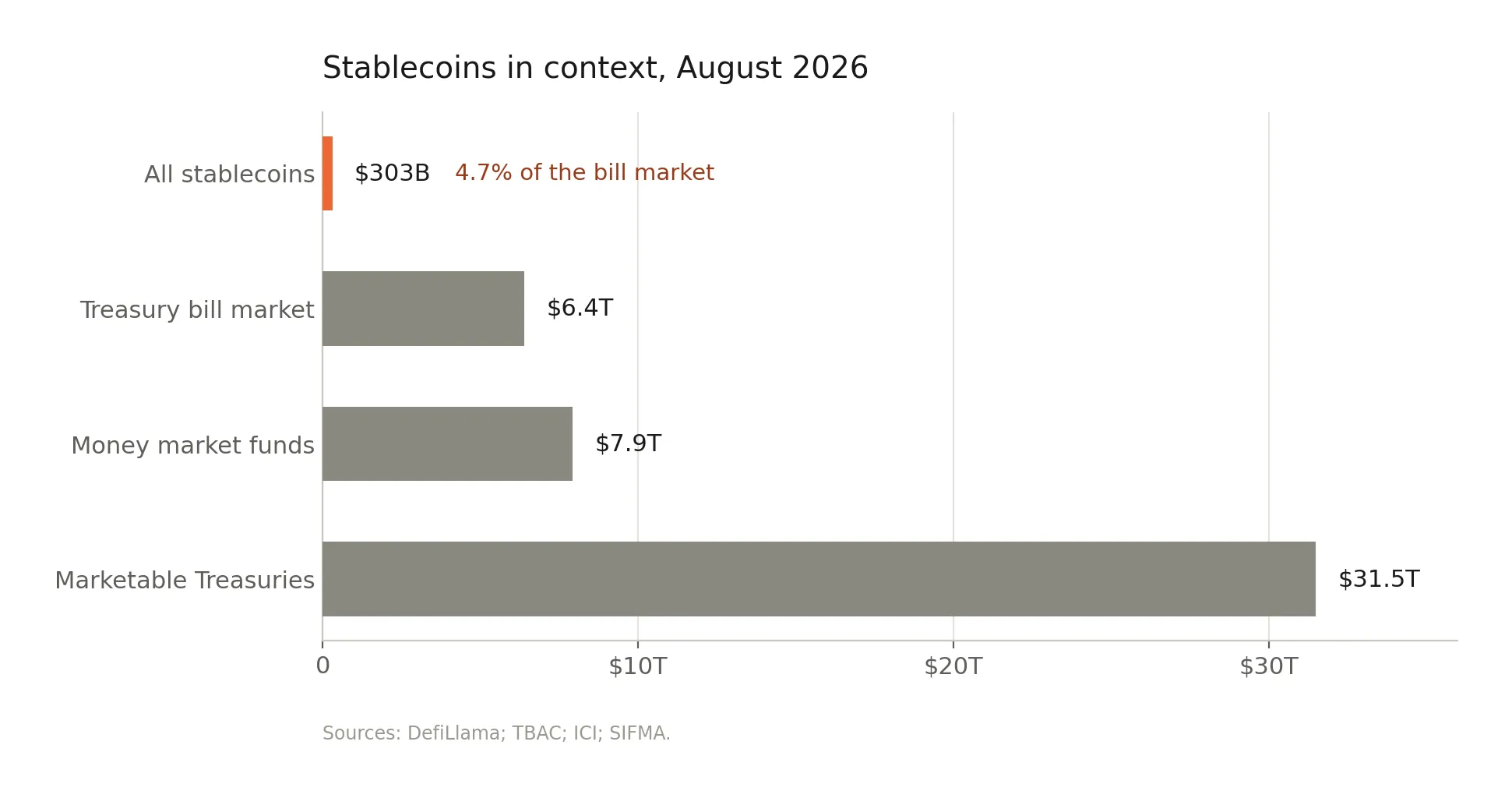
US debt crossed $40 trillion this month. Net interest ran $963 billion in the first ten months of fiscal 2026, roughly 15% of all federal spending, more than defence. The stock of marketable Treasuries is $31.5 trillion and growing about 8.6% a year.
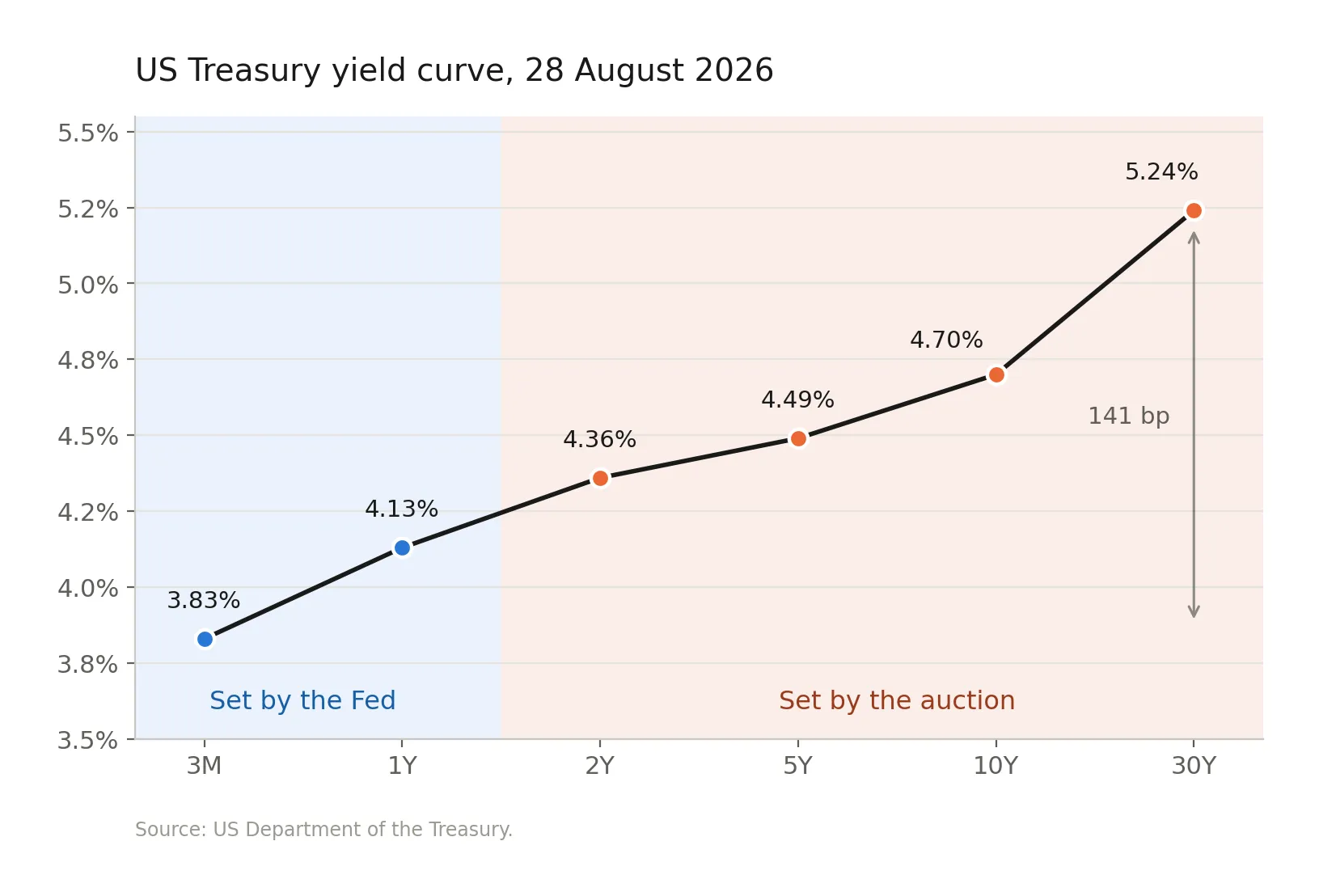
None of that is new. What is new is that the long end has started pricing it. The 30-year hit 5.24% in August, a level last seen before the financial crisis. The 10-year sits near 4.70%. On 19 August the Treasury made an unscheduled announcement doubling its buyback operations from $2 billion to at least $4 billion per issue in the 10-to-30-year sector. Bessent called it a “Treasury Twist” on CNBC and said it could go bigger. Officials then floated funding it out of the Treasury General Account, which held about $935 billion. Yields fell for a day and went straight back up.
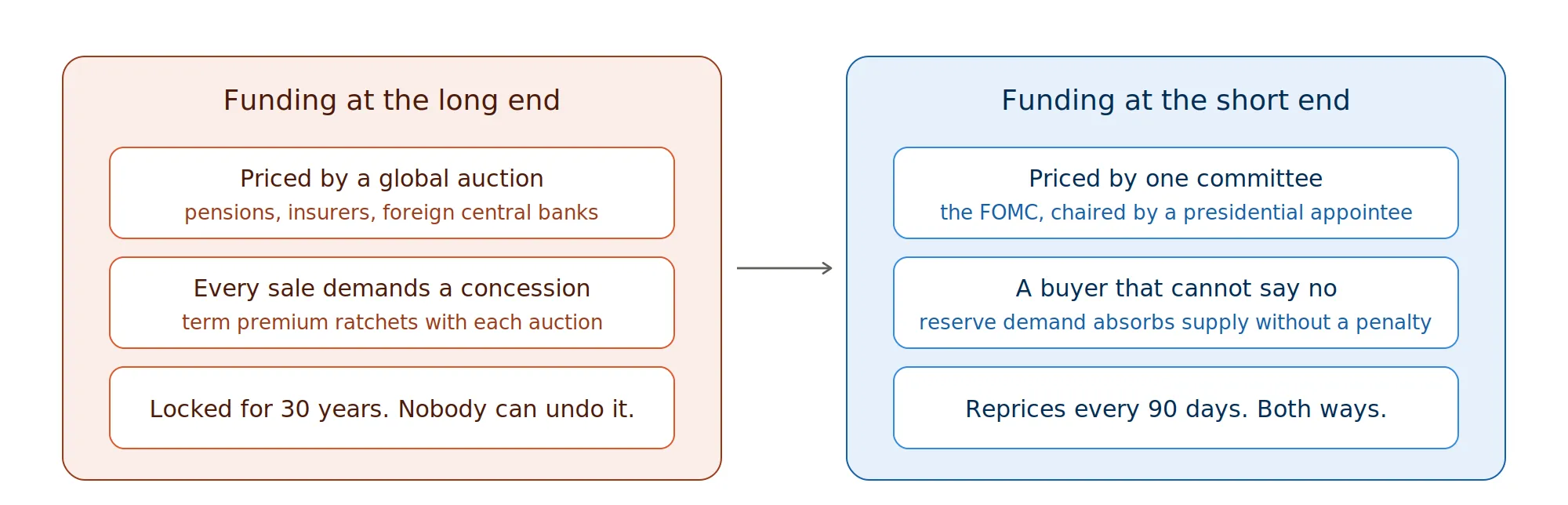
There are two interest rates in the US and they answer to different masters. The short end is set by the Federal Reserve, bills price off the expected path of the policy rate. The long end is set by an auction, where pension funds, insurers, foreign central banks and hedge funds decide what term premium they need to hold thirty years of duration and inflation risk. The Treasury has no vote in that second market. It can only choose how much duration to sell into it.
The 3-month bill yields 3.83%. The 30-year yields 5.24%. Treasury controls neither number, but it chooses which one it pays.
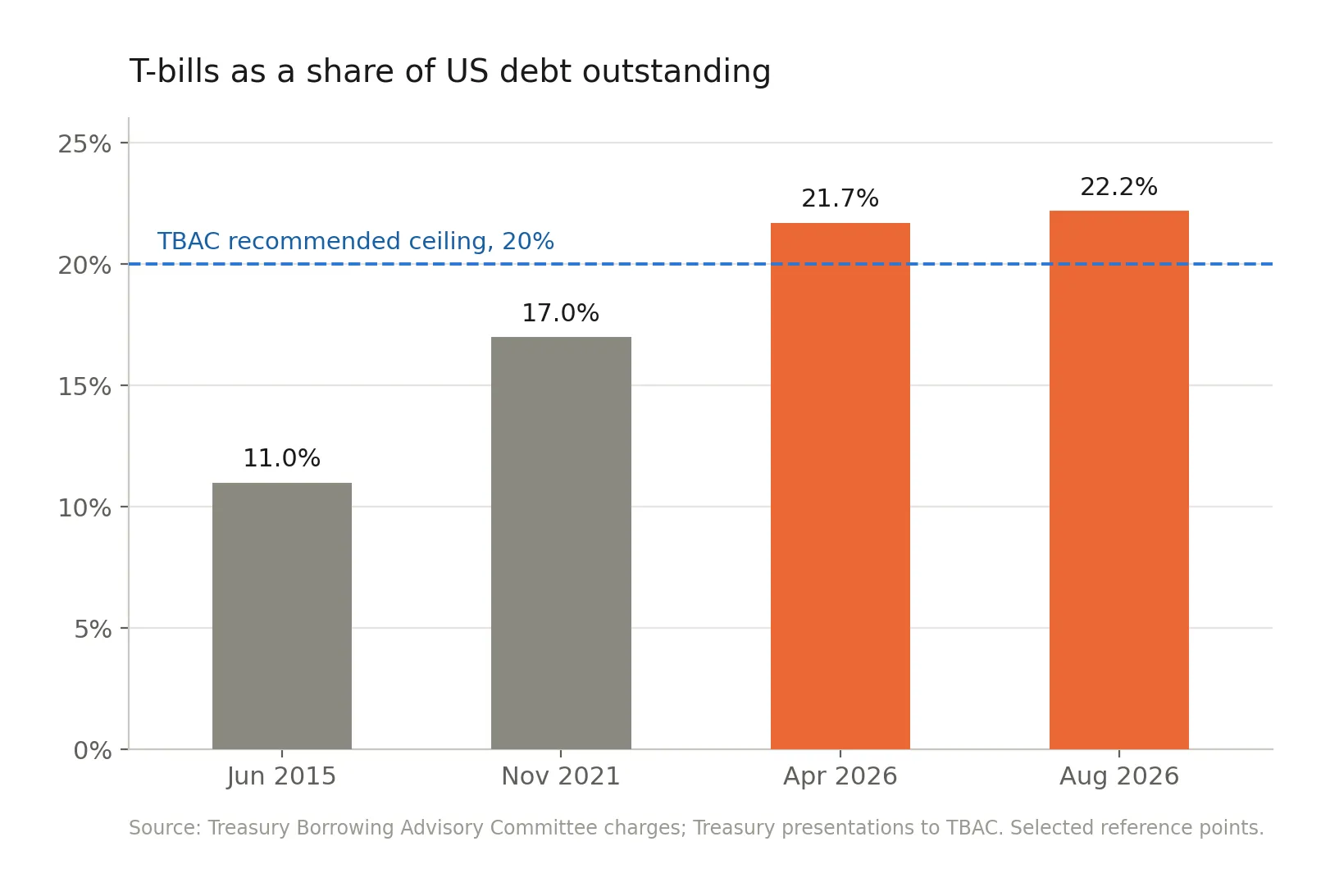
So it has been choosing less. Treasury has held its coupon auction guidance unchanged since early 2024. nine straight quarters of “at least the next several quarters” while borrowing needs climbed. Bills are now 22.2% of outstanding debt, above the roughly 20% ceiling the Treasury Borrowing Advisory Committee recommends. TBAC said in May that projections could warrant increasing coupon issuance for the fiscal year starting in October. On 5 August, Treasury declined and kept coupons flat. Arithmetically, if coupon sizes are frozen and the deficit grows, the bill share climbs on its own.
This is not a secret plan. It is published quarterly. What it needs is a buyer.
What GENIUS actually built
The GENIUS Act, signed 18 July 2025, does two things at once.
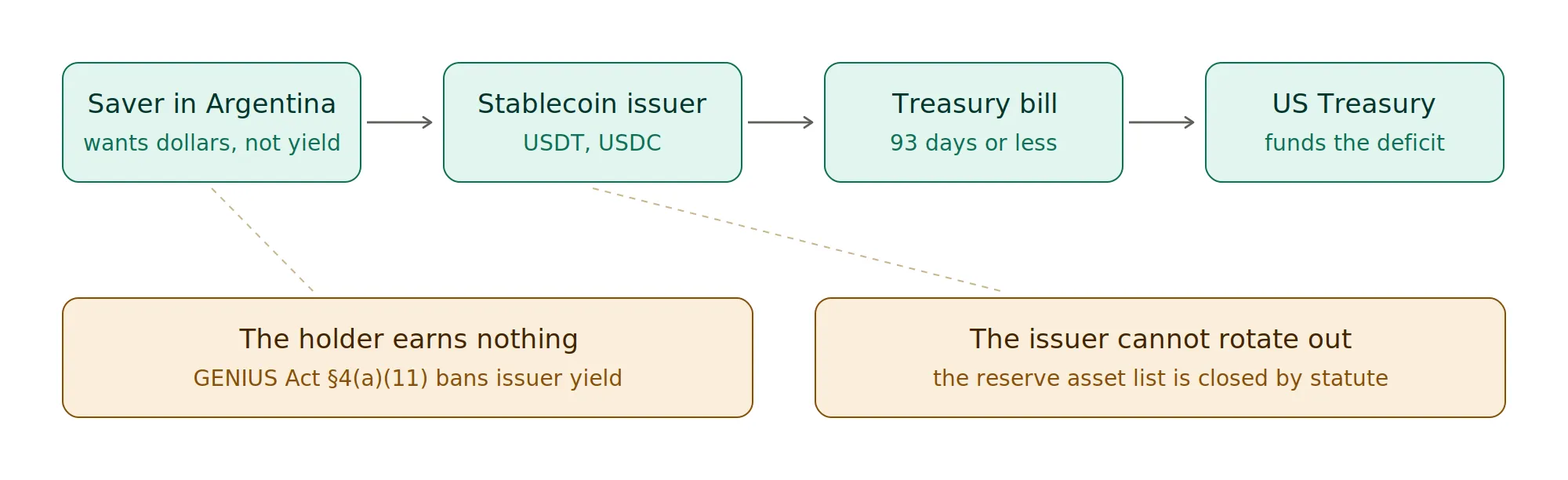
First, it closes the asset side. A permitted issuer’s reserves may only be cash, Federal Reserve balances, insured bank deposits, Treasury securities with 93 days or less remaining maturity, overnight repo backed by those bills, and government money market funds holding the same. That is the entire list. An issuer that thinks bills are expensive cannot express that view. It cannot buy corporate paper, extend duration, or sit in gold. The law forecloses substitution.
Second, it closes the liability side. Section 4(a)(11) bars issuers from paying holders any interest or yield for holding the token. So the person supplying the funding is contractually indifferent to the rate on the asset their money buys.
That combination is genuinely unusual. A money market fund competes for assets on yield, if bills go rich against repo, it rotates. A foreign central bank manages reserves against a mandate and will let its bill holdings run down, as China’s have, from over a trillion to roughly $756 billion. Both are price-sensitive in the way a bond market needs its marginal buyer to be.
Stablecoin reserve demand is not. It is derived demand from a payments and dollar-access business. Roughly two-thirds of stablecoin supply is held in emerging markets. In Argentina, over 60% of crypto transactions run through dollar stablecoins; the peso has lost more than 90% against the dollar in a decade. Someone in Buenos Aires or Lagos buying USDT is not comparing 3.83% to some alternative. They are comparing a dollar to a currency losing 30% a year. They will hold at zero, happily, and the issuer behind them will buy bills at whatever the auction clears, because the statute leaves nowhere else to put the money.
That is the actual asset, not a buyer who accepts low rates, but a buyer whose demand curve is vertical.
What that is worth and what it is not
Here is where the popular version overreaches. Captive demand does not let the government “set rates to whatever it wants.” Bill yields are anchored by the Fed’s policy rate through arbitrage against reserves and the reverse repo facility. No amount of price-inelastic bill demand moves that anchor. It moves the spread around it, by basis points.
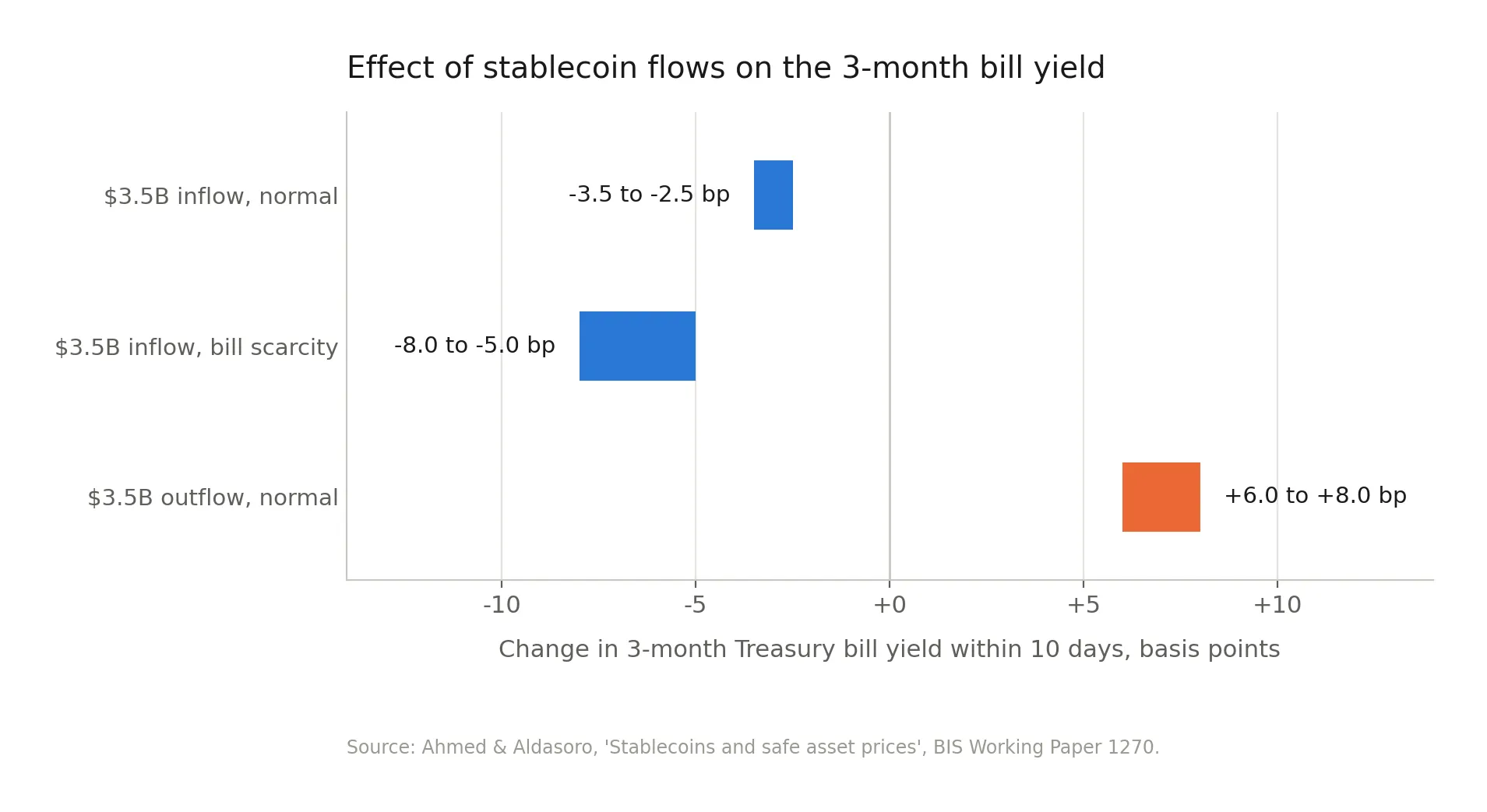
The empirical work says exactly that. The BIS working paper by Ahmed and Aldasoro finds a two-standard-deviation stablecoin inflow, about $3.5 billion, lowers 3-month bill yields by 2.5 to 3.5 basis points, rising to 5 to 8 during periods of bill scarcity, with no measurable spillover to longer maturities. A separate academic estimate puts Tether’s cumulative effect on 1-month yields at roughly 24 basis points versus a counterfactual, worth around $15 billion a year in interest savings.
The real prize is different, and bigger. It is the absence of a concession. When Treasury needs to raise a trillion dollars and the long end demands more term premium each time, every auction ratchets the cost of the next thirty years. When it raises the same trillion in bills into a buyer that cannot say no, it pays the Fed’s rate with no supply penalty, and it has moved the pricing authority for a growing share of $40 trillion from a diffuse global auction to a single institution with a chair appointed by the President.
That is the trade. Not cheaper debt. Contestable debt. The rate-setter becomes one committee instead of the whole world.
Which is why the interesting fight is not GENIUS. It is the Fed. And right now it is going the wrong way: Warsh used Jackson Hole to say inflation has not meaningfully slowed and that financial conditions are not restrictive, and markets are pricing roughly even odds of a hike in September. A debt stock financed at the front end reprices upward within months if that happens. The strategy is a leveraged bet on cuts.
Five ways this breaks
Scale. Stablecoins are about $303 billion today. The bill market is roughly $6.4 trillion; money market funds hold $7.93 trillion. Stablecoins are around 5% of the bill market. Even at Bessent’s $3-trillion-by-2030 figure, they are a large marginal buyer, not the price setter.
Substitution. The Brookings/Aspen paper by Liang and Neiman puts incremental bill demand anywhere from $400 billion to $2.3 trillion by 2030, a range that wide because it depends entirely on where the money comes from. Dollars leaving a money market fund for USDC produce zero net new bill demand; the fund sells what the issuer buys. Only genuine new dollarisation abroad is additive. Note also that a stablecoin replacing physical dollars is fiscally negative: banknotes cost the government nothing and remit their float to Treasury via the Fed, whereas the float on a stablecoin accrues to Tether, which cleared over $10 billion in the first nine months of 2025.
The captive base leaks. GENIUS bars issuers from paying yield. It says nothing about exchanges and affiliates that distribute the token, and it does not touch tokenised money market funds, which pass through the full bill rate by design. BUIDL and USYC are small today, a few billion each, but the OCC is already writing anti-circumvention rules, which tells you where the pressure is. Sophisticated dollars migrate to the yielding wrapper. The genuinely rate-indifferent base is emerging-market retail savings and payments float, not headline market cap.
Asymmetry. The same BIS work finds outflows raise yields by 6 to 8 basis points against 2 to 2.5 for equivalent inflows, redemptions hit two to three times harder. A separate BIS study found cash is only about 12% of representative reserve portfolios, and modelled roughly $10 billion of forced selling moving the weekly 3-month yield 2.9bp, $30 billion moving it 6.4bp. A buyer that cannot say no on the way up is a forced seller on the way down. You have financed a sovereign at the front end with a run-prone liability.
Duration. This is the one nobody wants to own. Financing a growing $40 trillion at three months means the entire stock reprices to the policy rate continuously. Treasury is currently buying back long bonds carrying roughly 3.4% coupons and replacing them with bills near 3.83%, retiring cheap locked debt for expensive floating debt, on purpose, because floating is controllable and locked is not. That is a bet, and the historical precedent is instructive: from 1942 to 1951 the Fed pegged bill rates near 3/8% and the long bond at 2.5% while inflation ran hot, and the debt-to-GDP ratio roughly halved. The bill holders and the bond holders paid for it. It ended with the Treasury-Fed Accord in 1951, when the Fed refused to keep doing it.
What I take from it
Nobody in Washington needs a conspiracy for this to happen. Treasury wants the cheapest funding it can get and does not control the long end. Emerging-market savers want dollars and do not care about yield. Issuers want a legal moat and got one. The incentives align without anyone having to draw the diagram.
But the diagram exists whether it was drawn or not, and it has three implications worth acting on:
- For anyone building in this sector: the regulated dollar-token business is now a sovereign funding utility whose entire margin is the policy rate. The industry is structurally long short-term rates and does not talk about it. A cutting cycle compresses issuer revenue at exactly the moment the fiscal logic wants supply to grow.
- For anyone holding duration: the marginal bid at the front end is increasingly correlated to crypto risk appetite, which is a new and badly understood source of volatility in the world’s benchmark safe asset.
- And for anyone holding dollars for the long term: the thing being engineered here is not default. It is a slow, legal transfer from savers in nominal instruments to the issuer of those instruments, via a rate held below inflation. It has been done before. It worked. Somebody paid for it, and it was not the borrower.